

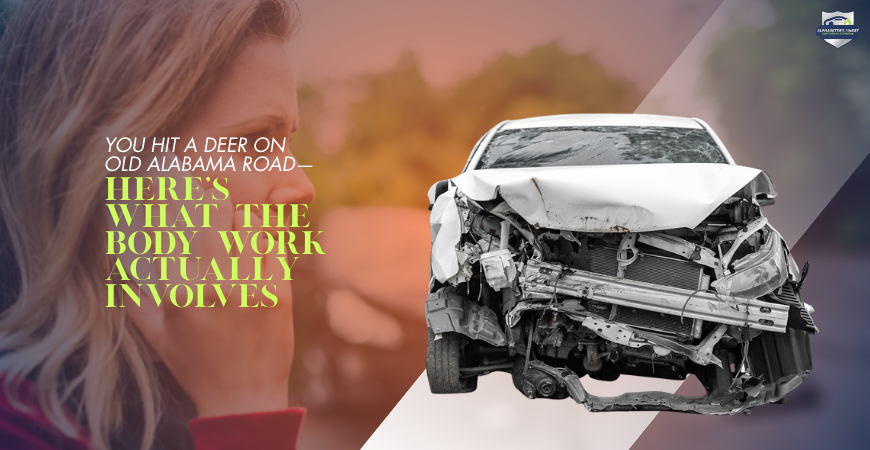
It takes about a second and a half. Something moves at the tree line. You brake. The front of the car takes it. The airbags don’t go off, the car still drives, and the damage looks like a caved-in bumper and a broken headlight.
It’s almost never only the bumper. Deer strikes load the front of a car unevenly and high, which is why they bend the parts you can’t see while leaving the parts you can look survivable. Alpharetta’s Finest does collision and body work for Audi, BMW, Land Rover, Mercedes, Porsche and the rest of the European and luxury lineup off Nine McFarland Drive. This is our season. Dusk now arrives during the drive home, and deer move at dusk.
Quick Summary: Key Takeaways
- The bumper cover is cosmetic: the absorber, reinforcement bar and radiator support behind it do the real work.
- Hood and fender gaps tell the truth: panels that no longer line up mean something structural moved.
- Headlamp housings crack at the mounting tabs: a lamp that still lights can still be unaimable.
- Measurement beats eyeballing: our certified Rhone XL alignment and straightening system by Celette puts the car back to factory dimensions.
- Photograph everything before it moves: your estimate and your claim both get easier.
Deer Damage Runs Deeper Than the Bumper Cover
Peel a modern front bumper off and three more layers sit behind it. A foam or honeycomb absorber, a steel or aluminum reinforcement bar, and the radiator support that ties the whole front of the body together. A deer hit compresses all of it at once.
Then there’s everything bolted to that structure. Headlamp brackets, washer bottles, parking sensors and their wiring, hood latch, grille shutters. A car that drives fine can still have a front clip sitting a quarter inch out of place, and that quarter inch is what makes a hood gap look wrong forever if nobody measures it.
Structural Movement Hides Behind Panels That Look Straight
This is the part that gets missed. Energy travels back through the reinforcement into the rails, and a rail pushed back even slightly changes every gap and every mounting point ahead of the firewall.
So the car gets measured rather than judged by eye. We use a certified Rhone XL alignment and straightening system by Celette, which anchors the body and compares it against factory dimensional data point by point. If it’s within spec, we say so and move on. If it isn’t, it gets pulled back to spec before a single new panel goes on, because hanging fresh parts on a bent structure is how a repair fails inspection six weeks later.
Welding and Panel Fit Come Before Any Paint
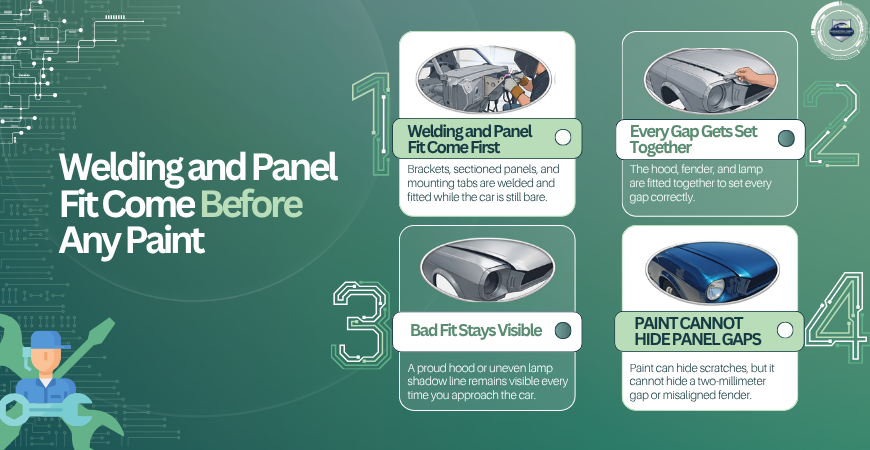
Sequence matters. Badly. Brackets, sectioned panels and mounting tabs get welded and fitted while the car is still bare, and every gap gets set with the hood, fender and lamp all in place at once.
Get that wrong and you’ll see it every time you walk up to the car — a hood that sits proud on one side, a lamp with a shadow line down one edge. Paint can hide a scratch. It cannot hide a two-millimeter gap, and no amount of buffing will make a misaligned fender look right in the Alpharetta parking-lot sun.
Paint Matching Is the Part Everyone Judges You On
Every owner checks the same thing at pickup. Does the new panel match the old one in daylight? On metallics and pearls it takes blending into the adjacent panels rather than painting to the edge and hoping.
Silver, white pearl and the darker BMW and Mercedes blues are the unforgiving ones, because the flake orientation shifts with spray angle and any hard line between old and new paint shows up at an angle. Our refinish work carries a lifetime paint warranty. That’s the level of confidence we’re prepared to put in writing.
Dusk Now Lands Right in the Middle of the Commute
The risk window is a clock problem, not a wildlife one. By the U.S. Naval Observatory’s sun tables, sunset in Alpharetta falls from 7:03 p.m. in mid-October to 5:37 p.m. by November 10 once the clocks change.
That shift drops full dusk straight onto the 5 o’clock drive along Old Alabama, Haynes Bridge and the creek crossings north of town, in the weeks deer are moving most. Slow down through the wooded stretches, and if one crosses, expect a second. They don’t travel alone.
Frequently Asked Questions
Q: What should I do right after hitting a deer?
A: Get the car somewhere safe, put the hazards on, and photograph the damage from several angles before anything is moved or towed. Report it to your insurer, and get a written estimate from a body shop rather than an over-the-phone guess.
Q: Does insurance cover hitting a deer?
A: An animal strike is normally handled under comprehensive coverage rather than collision, but the terms are yours to confirm with your carrier. We provide free written estimates and work with insurers throughout the repair.
Q: How long does front-end collision repair take?
A: It depends on what moved and what has to be ordered. A bumper, lamp and fender job is measured in days; a repair that needs structural pulling and parts from Europe can run longer, and we give you a timeline once the car has been measured.
Q: Can a cracked headlight housing be repaired instead of replaced?
A: Sometimes, if the damage is limited to the lens or an outer tab. Once a mounting point that controls aim is broken, replacement is the honest call — an unaimable lamp is a safety item, not a cosmetic one.
Bring It In and Let Us Measure It
Estimates are free. We’d rather look at the car than guess from photos on a phone. If the timing is awkward, there’s a 24/7 key drop box, a shuttle if you need a lift, and fleet accounts for company vehicles. Se habla español.
Alpharetta’s Finest Auto Collision & Detailing, 4075 Nine McFarland Dr, Ste C, Alpharetta, GA 30004. Open Monday through Friday, 9:00 AM to 5:00 PM. Online at alpharettasfinest.net.