


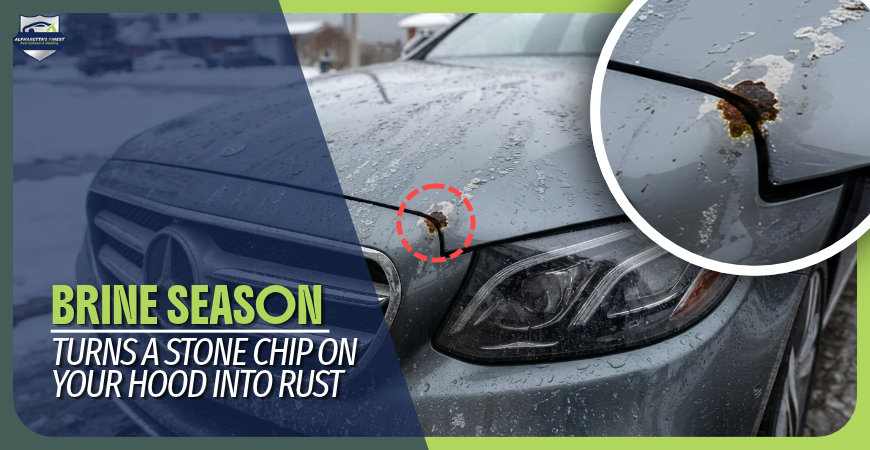
Most owners file stone chips under things to deal with eventually. That holds up fine for ten months of the year in north Georgia. From December through February it stops holding up, because the road surface changes and what lands on your paint changes with it.
Georgia DOT stocks roughly 1,950,700 gallons of brine statewide for the winter season, by its own winter weather resource list, and thirteen tankers put it down on metro Atlanta interstates up to 24 hours before a forecast event arrives. Brine is salt in solution. It gets thrown onto the front of every car on GA-400, and it goes wherever the paint film is broken.
Quick Summary: Key Takeaways
- Bare metal is the issue: a chip that reaches steel starts oxidizing within days of a brine exposure, while a dent in sound paint sits there for years.
- Brine clings: liquid de-icer stays on a vehicle after the roads dry, so winter chips rust faster than summer ones.
- The leading edges take the hits: hood edge, A-pillars, mirror caps, rocker panels and just behind the front wheels.
- A brown halo means it is past touch-up: the rust under the surrounding paint has to come out before anything new goes on.
- Inspect the paint in early winter: by March the blistering has already told you which chips you missed.
Why a break in the paint is all it takes
A modern paint system is four layers: electrocoat primer on the steel, a primer surfacer, color, then clear. The electrocoat is the corrosion protection and everything above it is appearance and UV defense. A stone that lifts all four leaves a pinhole of bare, unprotected metal sitting in an open-air salt bath.
Oxidation starts at the bottom of that pinhole and spreads sideways beneath the paint film, so a chip the size of a pencil tip can be hiding a dime of corrosion by spring. The surface looks stable right up until the paint above the rust lifts and flakes away in one piece.
Which chips a touch-up pen can actually handle
A fresh chip with clean, bright metal at the bottom and no discoloration around the edge is a touch-up candidate. Clean it, degrease it, build the color up in thin coats over a few days and let it sit proud, then level it. Done patiently, that seals the metal and buys years.
A chip with any brown staining at the edges is a different job. Painting over rust traps it, and the repair fails from underneath within a season. That one needs the corrosion mechanically removed, the area primed properly and the panel refinished and blended into the surrounding paint so the repair does not stand out in daylight.
Know two things about color before you order a bottle of touch-up and expect a miracle. The paint code on your door jamb gets you close, and on a solid white or black it gets you very close. On a silver, a gray metallic or any of the pearl finishes, the metallic flake has to lie down the same way it did on the production line for the patch to disappear, and a brush cannot make flake lie down. So a grain-of-rice chip on a metallic hood ends up looking like a dark freckle after a home repair, and anything on a visible horizontal panel should be sprayed.
Where to look, and when
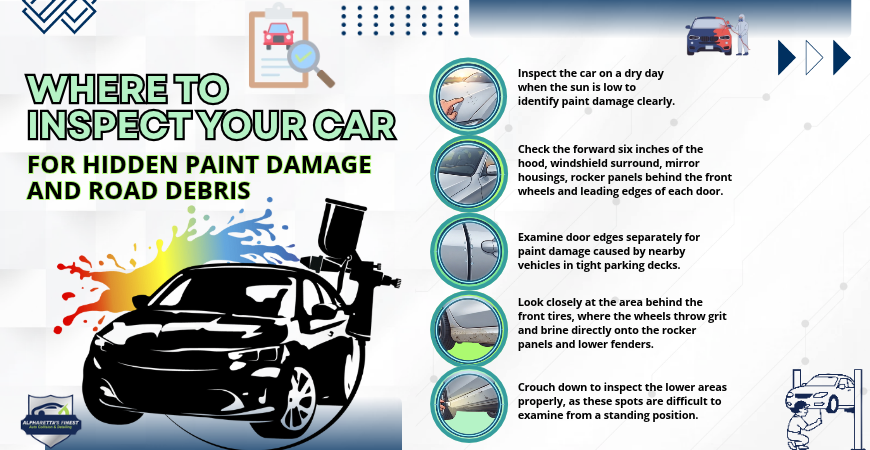
Walk the car on a dry day with the sun low. The places that collect damage on a commute up and down 400 are predictable: the forward six inches of the hood, the windshield surround, the mirror housings, the rocker panels behind the front wheels and the leading edge of each door.
Door edges deserve a separate look, because the damage there has nothing to do with the road. A door swung into the car beside you in a tight Alpharetta parking deck takes the paint off the very edge of the panel, where the coating is thinnest to begin with, and that edge then sits exposed to everything for the rest of the winter.
The one people miss is the area just behind the front tires, where the wheel throws grit and brine directly at the rocker and the lower fender. It is also where the paint is hardest to inspect, because you have to crouch down beside the car. Crouch down and look anyway.
Protecting what is still intact
For a vehicle that already has good paint, a ceramic coating gives the surface a harder, slicker barrier with real resistance to road salts and the other contaminants that sit on a car all winter, and it makes the washes between storms considerably more effective. It does not stop a rock. Nothing stops a rock. It does reduce how long salt residue stays in contact with the clear coat.
Washing matters more than any product. A wash after a brine event, including an underbody rinse, removes the thing doing the damage. North Georgia gets few enough events that the washing comes down to a handful of dates each winter, and people forget precisely because it comes up so rarely.
A December Chip Costs Less Than a March Panel
Repairing a chip in December costs a fraction of repairing the panel it becomes. Alpharetta’s Finest is at 4075 Nine McFarland Dr in Alpharetta, serving Johns Creek, Roswell and Cumming, and everything we do is listed at alpharettasfinest.net.